What are the Key Changes and New Requirements in CAF 4.0 for Critical Infrastructure?
The CAF (Cyber Assessment Framework) is the UK’s national model for assessing how organizations that deliver essential services manage cyber risk and resilience. Released by the UK NCSC (National Cyber Security Centre) in 2025, CAF 4.0 raises expectations by replacing checklist reviews with measurable, outcome-based resilience for critical infrastructure.
Key Updates
- Secure software development and lifecycle management across internal and supplier systems (A4.b)
- AI and automation risk controls to prevent unsafe or unintended system actions
- Proactive threat hunting as a mandatory capability under Principle C2
- Supply-chain assurance and subcontractor visibility
- Sector overlays for tailored application across energy, health, transport, and digital infrastructure
- Explicit emphasis on understanding threats (A2.b) and validating security through IGPs (Indicators of Good Practice)
Aligned with NIS2 (the EU’s updated Network and Information Systems regulation) and the UK Resilience Bill, CAF 4.0 increases board-level accountability and requires continuous evidence of governance and improvement under Objectives A-D.
How Does CAF 4.0 Differ from Previous Versions?
CAF 4.0, developed by the NCSC, moves beyond checklist compliance toward measurable outcomes and continuous improvement. It introduces new principles such as Threat Hunting (C2) and Secure Software Development (A4.b), supported by sector-specific overlays.
Key Differences
- Outcome-based evidence replaces control lists, giving organizations flexibility in meeting each principle
- IGPs guide expert judgment rather than rigid scoring
- New principles for threat hunting (C2) and secure software development (A4.b)
- Supports sector-specific overlays let regulators adapt expectations to each industry
- Stronger focus on governance and assurance, requiring board-level ownership
In practice, CAF 4.0 demands verifiable evidence and documented threat-hunting procedures. Earlier versions emphasized network monitoring whereas 4.0 adds a dedicated Threat Hunting principle requiring proactive hunts and validated results.
Common CAF 4.0 Challenges and How the Framework Solves Them
| Pain Point | How CAF 4.0 Addresses It |
|---|---|
| Navigating complex, overlapping regulatory requirements | CAF 4.0 aligns with the NIS2 Directive and the UK Resilience Bill, creating a unified model for governance, assurance, and resilience across sectors. |
| Limited resources for continuous evidence collection and threat monitoring | CAF 4.0 replaces checklist-style audits with outcome-based evidence and continuous assessment, allowing organizations to demonstrate compliance more efficiently. |
| Uncertainty about how to operationalize new mandates around secure development and AI risk | CAF 4.0 introduces clear principles for Secure Software Development [A4.b] and AI Risk Management, providing structured guidance on lifecycle controls, testing, and provenance. |
| Difficulty producing board-ready compliance and resilience reports | CAF 4.0 strengthens executive accountability through measurable objectives and IGPs (Indicators of Good Practice), making board-level reporting more consistent and data-driven. |
AI Risks & Secure Development are Priorities in CAF 4.0
CAF 4.0 recognizes that AI-driven automation and complex software supply chains create new risks that can disrupt essential services if development and management are not secure.
Requirements for Organizations
- Apply secure development practices such as code provenance tracking, testing, and vulnerability management throughout the software lifecycle
- Assess and control risks from AI-driven or automated decision systems that could act unpredictably or be manipulated by attackers
- Verify the authenticity and integrity of software and updates through supplier assurance processes that enforce secure-development standards
These updates formalize secure development and AI-risk management to keep vulnerabilities out of critical systems before deployment and align with the NIS2 Directive and the UK Resilience Bill.
New Sector Overlays & Their Effect on Security Leaders
CAF 4.0 introduces sector-specific CAF profiles, or overlays, to make the framework practical for industries that deliver essential services. Developed under the NCSC’s guidance, these overlays ensure the CAF remains a shared national framework while allowing for sector-specific interpretation.
Think of the overlays as tailored blueprints that adapt the same framework to each sector’s operational realities where each one adapts CAF outcomes to the specific risks, technologies, and regulatory expectations of its sector.
Key Objectives of the Sector Overlays
- Sector-specific interpretation: Ensure energy, healthcare, transport, and digital infrastructure operators can apply CAF principles within their operational context
- Regulatory alignment: Allow regulators to define resilience targets that reflect real-world operational conditions
- Leadership focus: Help security leaders concentrate on the outcomes most critical to their essential functions
- Consistent measurement: Support uniform assessment of cyber maturity across IT and OT environments
For leadership teams, these overlays clarify what “good” looks like in each domain and turn CAF 4.0 into a practical tool for prioritizing risk and evidence, not just another checklist.
OPSWAT Solutions Simplify & Operationalize CAF 4.0 Alignment
OPSWAT solutions align with CAF 4.0 outcomes, turning framework objectives into measurable operational controls across IT and OT environments.
Key Areas of Alignment
- Threat prevention and detection aligned with CAF Objectives B (Protecting against cyberattack) and C (Detecting cybersecurity events), supported by MetaDefender Core™ and MetaDefender Aether™ for C2 Threat Hunting through machine-learning and behavioral analysis
- Secure development verification through SBOM generation and vulnerability scanning within MetaDefender Core provide measurable assurance for software integrity
- Automated reports provide visibility and audit readiness
- Cross-domain secure file exchange between isolated networks helps protect data flows
With CAF-aligned compliance mapping, OPSWAT helps your security team move beyond checklist compliance to achieve continuous assurance and measurable resilience. The table below shows how OPSWAT’s technologies map to CAF objectives, helping organizations demonstrate measurable, evidence-based compliance.
How OPSWAT Technologies Help Organizations Meet CAF 4.0 Challenges
| Pain Point | How OPSWAT Addresses It |
|---|---|
| Navigating complex, overlapping regulatory requirements | OPSWAT’s compliance mapping unifies CAF 4.0, NIS2, and the UK Resilience Bill into a single reporting framework. Automated alignment between objectives and controls reduces the need for separate audits. |
| Limited resources for continuous evidence collection and threat monitoring | MetaDefender Core, MetaDefender Managed File Transfer, and My OPSWAT Central Management automatically collect logs, audit trails, and control-status data. These features provide continuous evidence without manual tracking. |
| Uncertainty about how to operationalize secure development and AI risk controls | MetaDefender Core validates software authenticity, generates SBOMs, and manages vulnerability data, while Sandbox performs AI-assisted behavioral analysis to identify unsafe or manipulated code before deployment. |
| Difficulty producing board-ready compliance and resilience reports | OPSWAT’s centralized compliance views and reporting turn technical evidence into executive-level summaries mapped to CAF objectives A–D. This gives leadership clear visibility of compliance maturity and risk posture. |
OPSWAT Enables Evidence-Driven Compliance for CAF 4.0
You can simplify CAF 4.0 reporting with OPSWAT's automated evidence collection, centralized compliance views, and real-time mapping of data points to CAF objectives. These CAF 4.0 practices are already reflected in OPSWAT deployments across critical-infrastructure environments.
Key OPSWAT Capabilities Supporting Continuous CAF Assurance
- SBOM generation and vulnerability detection provide direct evidence of secure-development practices under CAF A4.b, linking technical proof to specific OPSWAT products and outcomes.
- Audit reports from MetaDefender Core and MetaDefender Managed File Transfer™ map to CAF Objectives A and D, giving CISOs traceable, regulator-ready summaries that demonstrate compliance progress
Key Capabilities of OPSWAT Technologies
Centralized compliance views that visualize compliance status against CAF objectives in real time
Automated collection of logs, reports, and audit trails that support continuous evidence gathering
Supervisor approval workflows and detailed audit logs document file movement, policy enforcement, and human oversight in line with CAF Objective D2
Logic-based filtering and periodic rescanning further support CAF’s continuous review requirement by automating compliance verification against new or emerging threats
Integration with secure file transfer, access control, and threat analysis tools to verify data integrity
What Makes OPSWAT’s Cross-Domain Coverage Unique for IT/OT Security?
CAF 4.0 calls for unified security controls across IT and OT systems supporting essential functions. OPSWAT’s unified platform protects data flows, devices, and networks wherever they intersect. This approach supports the CAF’s sector overlays for energy, transport, and digital infrastructure, where regulatory expectations increasingly require unified visibility across IT and OT systems.
While some vendors focus narrowly on OT visibility or IT-based monitoring, OPSWAT’s CAF-aligned platform protects both domains under a single security and compliance model.
Core Differentiators
- Integrated protection for IT and OT systems
Combines technologies such as MetaDefender Core, MetaDefender Managed File Transfer, MetaDefender Drive™, and MetaDefender Kiosk™ to secure file exchanges and endpoints across connected and air-gapped environments
- Secure, policy-based file transfer
MetaDefender Managed File Transfer automates file movement between networks using workflow rules, approval processes, and audit logs to maintain compliance and data integrity
- Device assurance with pre-boot Multiscanning
MetaDefender Drive performs bare-metal Multiscanning and File-Based Vulnerability Assessment before endpoints connect to networks, helping prevent the spread of malware
- Media sanitization for removable media
MetaDefender Kiosk uses Proactive DLP™ and secure-erase options to validate and sanitize removable media before entry into secure environments
- Centralized visibility and reporting
MetaDefender Core, Managed File Transfer, and My OPSWAT™ Central Management provide unified dashboards, SIEM integrations, and audit logs that show device, user, and file activity across managed environments
How Are Advanced Threat Hunting & AI Risk Addressed in OPSWAT’s Products?
OPSWAT detects hidden threats and validates AI-driven software behavior through MetaDefender Aether, MetaDefender Threat Intelligence™, and MetaDefender Core, fulfilling CAF 4.0 Objectives C2 and B4.a within the NCSC’s Cyber Assessment Framework 4.0.
Core OPSWAT Capabilities
- Metascan™ Multiscanning and Real-time threat intelligence: uncover advanced and zero-day threats across file exchanges and devices
- Sandbox analysis: detects malicious behavior even without known indicators, correlating results through MITRE ATT&CK (Adversarial Tactics, Techniques, and Common Knowledge) mapping for structured evidence
- AI-assisted analysis: validates automated decisions and flags anomalies in system behavior
- Continuous updates to these technologies: align with evolving CAF 4.0 expectations
Together, these capabilities deliver high detection accuracy against both known and emerging threats while providing verifiable evidence for CAF assessments.
The table below summarizes how OPSWAT’s technologies align with the Cyber Assessment Framework (CAF) 4.0 objectives and principles, demonstrating how each product contributes to measurable, evidence-driven compliance across IT and OT environments.
OPSWAT Product Capabilities Mapped to CAF 4.0 Objectives and Principles
| OPSWAT Product | 主要功能 | CAF 4.0 Objectives / Principles Addressed | How the Feature Supports CAF 4.0 Compliance |
|---|---|---|---|
| MetaDefender Core™ |
|
|
|
| MetaDefender Aether™ |
|
|
|
| MetaDefender Threat Intelligence™ |
|
|
|
| MetaDefender Managed File Transfer™ 管理式文件传输 |
|
|
|
| MetaDefender Kiosk™ |
|
|
|
| MetaDefender Drive™ |
|
|
|
| MetaDefender Access™ |
|
|
|
| MetaDefender NetWall™ |
|
|
|
| My OPSWAT™ Central Management |
|
|
|
From secure development and supply chain assurance to proactive threat hunting and OT network protection, this integrated mapping provides both regulators and security leaders with traceable, data-driven proof of resilience.
By unifying visibility across your file flows, devices, and networks, OPSWAT helps you show you’re aligned with every CAF objective while maintaining operational efficiency and readiness for evolving threats. This approach not only accelerates CAF 4.0 compliance but also strengthens long-term cyber resilience across regulated sectors.
How Can Security Leaders Reduce CAF 4.0 Compliance Complexity & Ambiguity?
You might find CAF 4.0 complex because it’s built on outcome-based structure that overlaps with other regulations like NIS2 and the UK Resilience Bill. As a security leader, you can reduce complexity by using integrated compliance tools that automate evidence collection and reporting, minimizing manual effort while maintaining alignment with evolving regulations.
- Interpret outcomes through sector overlays rather than rigid controls
- Standardize evidence collection with automated, verifiable data
- Use unified reporting to consolidate CAF, NIS2, and Resilience Bill requirements
This approach streamlines multi-framework compliance, maintains real-time visibility across CAF objectives, and helps you demonstrate measurable progress with less administrative overhead.
What Steps Should CISOs Take to Prepare for a CAF 4.0 Assessment?
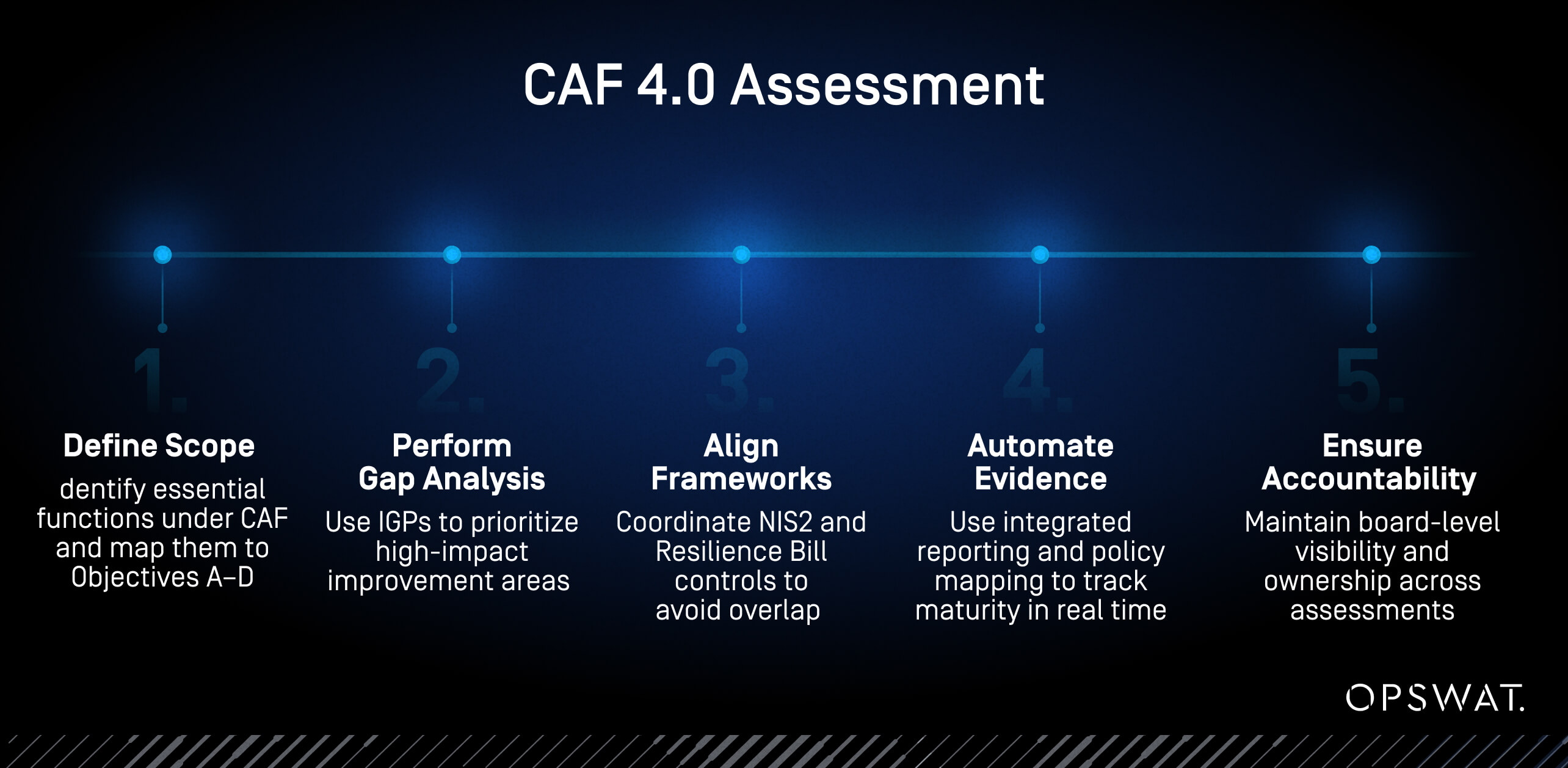
CISOs can prepare effectively by focusing on readiness, evidence collection, and cross-regulatory alignment. The goal is to make CAF assessments predictable, not reactive, through scope identification, gap analysis, and automated evidence collection aligned to Objectives A–D.
- Identify essential functions that fall under CAF scope and map them to the four core objectives
- Conduct a gap analysis using the updated IGPs to prioritize high-impact areas
- Align security controls with NIS2 and the UK Resilience Bill to avoid redundant audits and overlapping obligations
- Automate data collection early through integrated compliance reporting and policy mapping to track control maturity in real time
- Establish clear accountability at the board level to maintain continuous visibility between assessments
Outcome: A readiness model that replaces manual preparation with continuous assurance and evidence-based governance.

3 Ways to Efficiently Gather Evidence for a CAF Audit
By collecting evidence efficiently, you can turn CAF audits from one-off exercises into continuous assurance. Standardized templates and automated reporting help your organization track outcomes in real time and maintain consistent, verifiable proof of compliance.
- Use CAF-specific templates and automated data collection to link each control to measurable outcomes
- Centralize evidence within integrated compliance views to monitor progress against CAF objectives in real time
- Generate concise, auditor-ready summaries directly from automated reports to reduce preparation time and errors
OPSWAT Addresses Regulatory Ambiguity Across Sectors
CAF 4.0’s sector overlays allow each industry to interpret outcomes according to its own operational risks, but many organizations operate across multiple sectors. “OPSWAT products share a unified reporting and control architecture that allows organizations to track similar safeguards across multiple environments. This consistency helps multi-sector operators maintain regulatory alignment without duplicating evidence or audits.
What Evidence & Documentation Are Needed to Demonstrate CAF 4.0 Compliance?
CAF 4.0 requires measurable, system-generated evidence that links every control to an outcome across Objectives A–D. It’s not enough to show that controls exist. They must operate effectively and consistently over time. OPSWAT simplifies this process with automated data collection and customizable reporting that deliver both technical proof and executive-level summaries.
3 Types of Evidence that Satisfy CAF 4.0 Expectations
The 3 Categories of CAF Evidence
- Policy and governance documentation: risk registers, security policies, incident response plans, and supplier assurance records
- Operational and technical data: system logs, configuration files, vulnerability assessments, and file-scanning reports from live environments
- Assurance outputs: internal audit findings, test results, and maturity reviews aligned with the Indicators of Good Practice (IGPs)
NCSC guidance emphasizes that evidence must demonstrate continuous operation, not point-in-time compliance. OPSWAT’s integrated log collection, audit trails, and verification reports ensure each CAF control can be validated with system-generated data rather than manual records.
Spreadsheet Mapping Makes Compliance Actionable
Spreadsheet mapping links each CAF outcome to specific technical controls, showing where evidence is complete, partial, or missing. It provides instant visibility into compliance maturity and highlights actionable next steps.
You can link CAF outcomes to OPSWAT’s integrated reporting dashboards and audit data to track control status in real time. In pilot deployments with critical infrastructure operators, this approach has reduced manual reporting effort by more than 50% while improving audit readiness.
What Does Board-Ready Reporting Look Like for CAF 4.0?
Board-level reporting requires clear summaries of risk posture, control maturity, and regulatory alignment. OPSWAT’s integrated reporting dashboards provide clear visual summaries that translate technical metrics into business-level insight.
Sector-Specific Guidance Accelerates CAF 4.0 Adoption
You’ll face distinct operational risks depending on your sector, which is why CAF 4.0 includes tailored guidance to show how outcomes apply in your environment. These adaptations help organizations adopt controls more efficiently and align them with real-world operations. OPSWAT supports this with automated reporting and modular product configurations that can be adapted to different operational environments.
The Most Critical CAF 4.0 Objectives for CI Sectors
CAF priorities differ across industries, but all share the same goal of safeguarding essential services. The right combination of targeted guidance and automation accelerates CAF 4.0 adoption while ensuring controls remain proportionate and measurable across industries.
能源
System resilience and OT network segmentation are key. OPSWAT’s MetaDefender NetWall™ and MetaDefender Drive help isolate environments and validate endpoint integrity before connection.
医疗保健
Protecting patient data and clinical workflows is paramount. MetaDefender Managed File Transfer and MetaDefender Aether ensure every file transfer and upload is verified, sanitized, and traceable.
Transport
Availability and data integrity drive compliance. OPSWAT’s integrated reporting and policy-based transfer automation maintain visibility and control across distributed systems.
Digital Infrastructure
Threat detection and secure software development are core. MetaDefender Core and Threat Intelligence enable continuous vulnerability assessment and proactive defense.
Are There Sector-Specific CAF Implementation Templates Available?
Organizations can use OPSWAT’s configurable dashboards and reporting features to align their controls with sector-specific CAF outcomes. These tools provide real-time visibility into control status across environments, helping teams apply consistent standards and streamline onboarding as they adopt CAF 4.0 practices.
How Resource-Constrained Organizations Prioritize Controls for Maximum Resilience
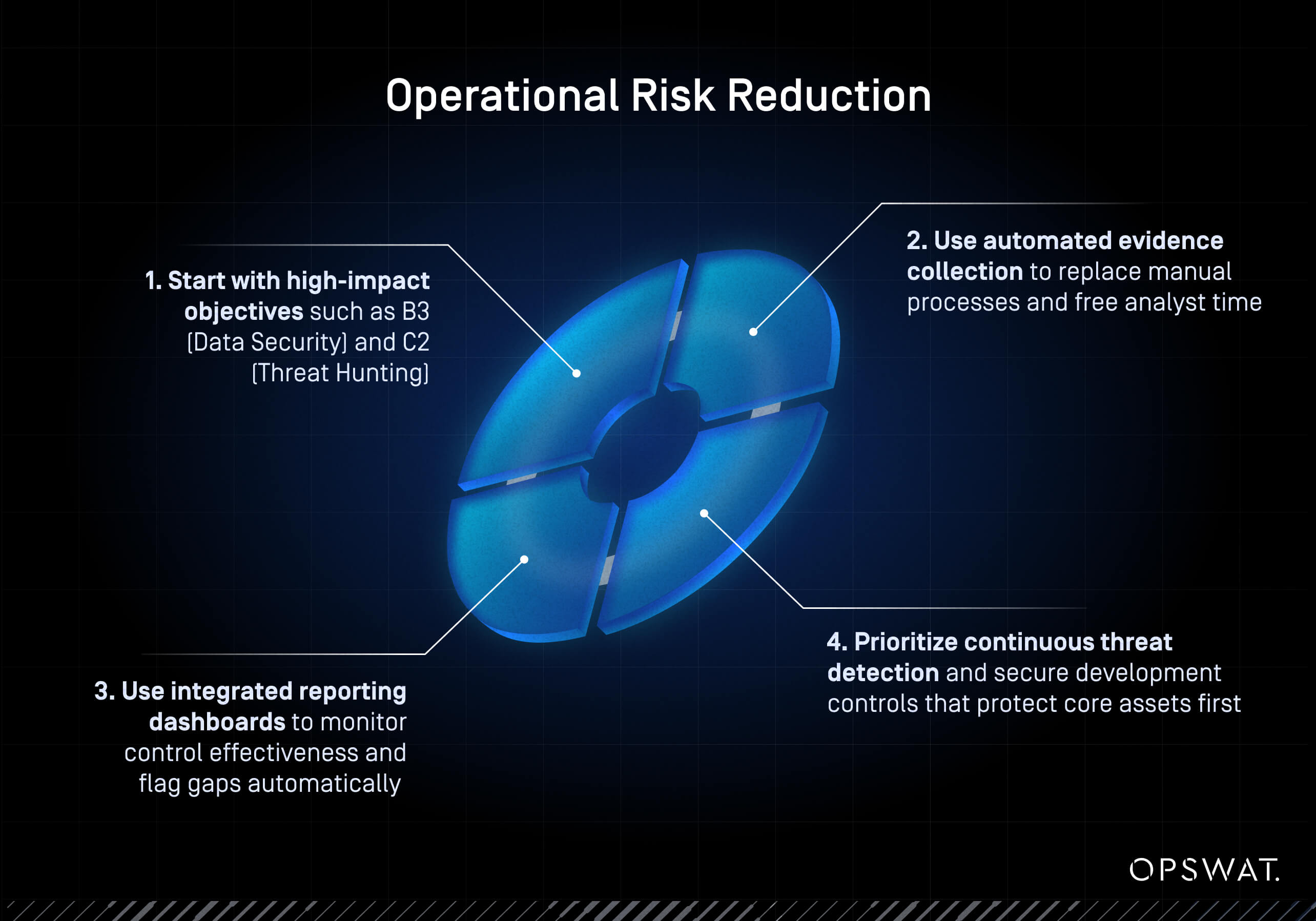
When resources are limited, focus on the controls that will give you the greatest reduction in operational risk. Automation and continuous intelligence act as force multipliers, allowing smaller teams to achieve the same level of CAF 4.0 assurance as larger organizations.
- Start with high-impact objectives such as B3 (Data Security) and C2 (Threat Hunting)
- Use automated evidence collection to replace manual processes and free analyst time
- Prioritize continuous threat detection and secure development controls that protect core assets first
- Use integrated reporting dashboards to monitor control effectiveness and flag gaps automatically

What Makes CAF 4.0 a Strategic Asset?
CAF 4.0 positions compliance as your strategic enabler by aligning your security performance with measurable business outcomes. It enables organizations to quantify cyber maturity, demonstrate continuous assurance, and prioritize investments that directly strengthen resilience. OPSWAT’s automated data collection and reporting link operational data to measurable security outcomes. This gives you clear visibility into how every control supports mission continuity.
Continuous Intelligence can Future-Proof Compliance & Defense
Real-time intelligence ensures that CAF 4.0 compliance evolves alongside the threat landscape. OPSWAT’s platforms automatically update malware engines and threat feeds from zero-day exploits to AI-driven attacks. This constant update cycle keeps assessments accurate and ensures that regulatory evidence reflects the organization’s true security posture at any given time.
When you’re navigating CAF 4.0 compliance and sector-specific mandates, OPSWAT helps you protect every file, device, and data flow through trusted threat prevention and compliance automation technologies.
Connect with an OPSWAT expert to accelerate your CAF 4.0 readiness.
常见问题
What are the key changes in CAF 4.0 compared to previous versions?
CAF 4.0 replaces checklist-based compliance with measurable outcomes and continuous assurance. It introduces secure software development requirements (A4.b), AI and automation risk controls, and a formal Threat Hunting principle (C2). The framework also adds sector overlays for energy, health, transport, and digital infrastructure, and strengthens governance expectations under NIS2 and the UK Resilience Bill.
How can UK CNI organizations demonstrate evidence-based compliance with the Cyber Assessment Framework?
You must ensure evidence is system-generated, traceable, and linked to CAF objectives. OPSWAT enables this through automated logging, integrated reporting, and policy-based workflows that align each control with measurable outcomes. Continuous monitoring replaces manual spreadsheets, helping CNI operators verify performance and present auditable proof of compliance.
What types of evidence or documentation are required to meet CAF 4.0 expectations for board-level reporting?
You should review a mix of governance records (policies, risk registers), operational data (logs, vulnerability reports), and assurance outputs (audits, test results). OPSWAT consolidates these into concise compliance summaries that link technical metrics to CAF objectives, giving executives real-time insight into maturity and resilience without deep technical review.
How does the CAF framework align with upcoming UK resilience and security regulations, like NIS2 and the Resilience Bill?
CAF 4.0 aligns closely with NIS2 and the UK Resilience Bill by emphasizing continuous improvement, board accountability, and evidence-driven assurance. OPSWAT’s compliance mapping and automated reporting let organizations satisfy overlapping requirements through a single, outcome-based workflow instead of maintaining separate audits for each mandate.
What are the best practices for implementing threat hunting and secure development processes under CAF 4.0?
Adopt proactive threat hunting (C2) using tools that detect abnormal behavior even without known indicators. Integrate secure development practices (A4.b) — such as SBOM (Software Bill of Materials) generation and vulnerability scanning — into every release. OPSWAT supports both through MetaDefender Aether, Core, and Threat Intelligence, providing automated detection, MITRE ATT&CK mapping, and verifiable code integrity.
How can resource-constrained public sector bodies prioritize CAF 4.0 controls to maximize cyber resilience?
Focus first on high-impact objectives (B3 Data Security, C2 Threat Hunting) that reduce operational risk the most. Automate evidence collection and file-flow protection to save analyst time. OPSWAT’s continuous intelligence and integrated compliance reporting let smaller teams maintain CAF-level assurance with fewer resources while keeping pace with evolving threats.