不容错过的更新:Office 2016 与 Office 2019 支持终止

立即阅读
我们利用人工智能进行网站翻译,虽然我们力求准确,但不一定总是 100%精确。感谢您的理解。

Content Disarm & Reconstruction (CDR): 8 Best Vendors in 2026

By OPSWAT
分享此贴

导言

File-based threats remain one of the most persistent and evasive risks to enterprises, from zero-day exploits in documents to APTs hidden in seemingly safe files. As organizations work to secure every file entering their environment, Content Disarm and Reconstruction (CDR) has become a critical layer of defense.

Unlike detection-based tools, CDR proactively removes threats by rebuilding files into safe, usable versions. This guide compares the eight best CDR vendors for 2026, helping security leaders evaluate capabilities and confidently shortlist the right solution.

What Is Content Disarm and Reconstruction (CDR) and Why Does It Matter for Enterprise in 2026?

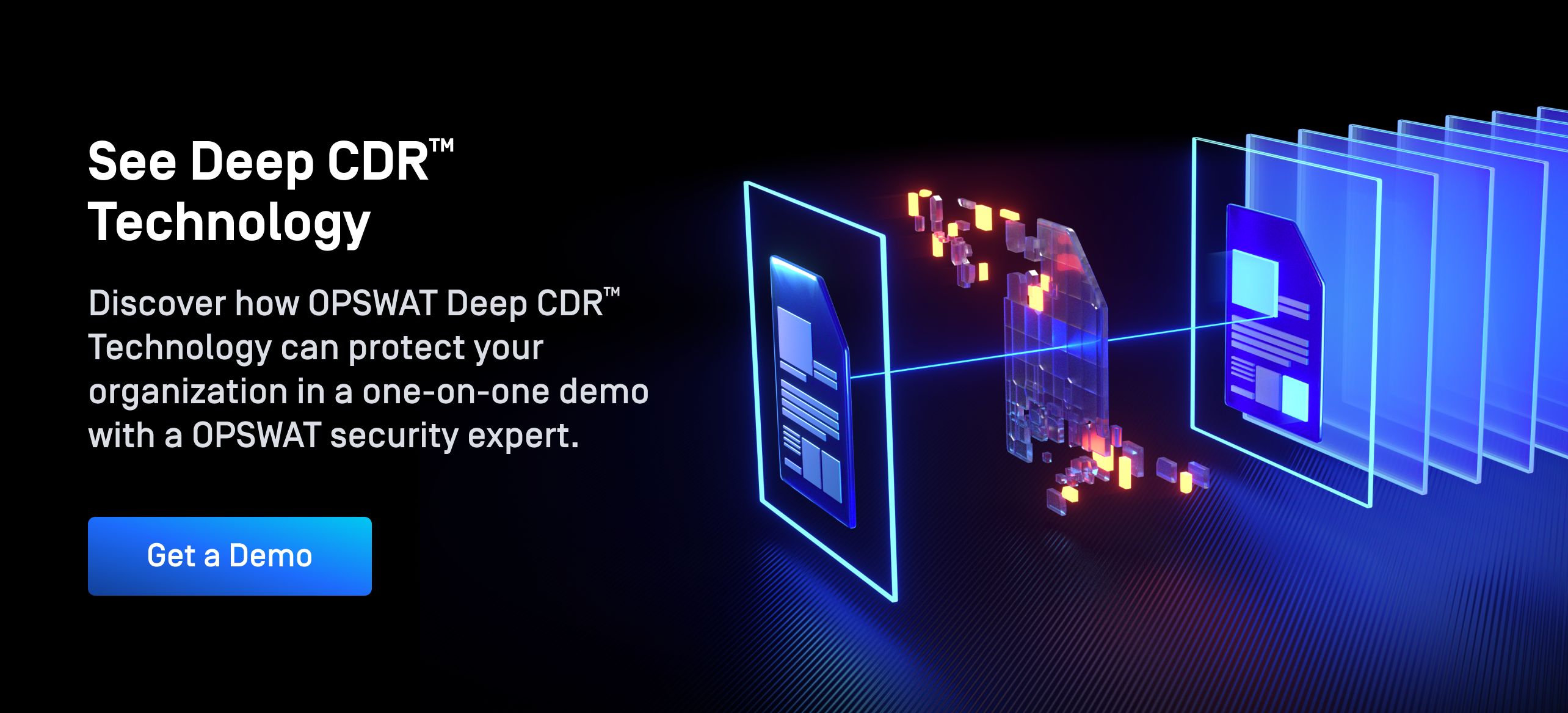
CDR is a proactive file sanitization technology that neutralizes potential threats by removing malicious artifacts from files. Instead of trying to identify malware, CDR disassembles a file, strips out unsafe elements like macros or embedded code, and rebuilds a safe, usable version for end users.

这种方法可确保通过电子邮件、下载、文件传输或协作工具进入企业的文件不含隐藏的恶意有效载荷,从而在保护组织的同时不影响工作效率。

How CDR Works to Neutralize File-Based Threats

CDR breaks a file into components, validates the structure, removes active or non-compliant elements like macros, scripts, exploits prone objects, malformed markup, and suspicious links, then reconstructs a safe file that preserves content and usability. Originals can be quarantined or sent to a sandbox for forensic analysis, depending on policy.

Key Benefits of CDR for Enterprise Security Posture

  • Prevents known and unknown threats, including zero day and evasion techniques
  • Delivers clean files in seconds, with minimal user friction
  • Reduces reliance on signatures, detonation, and human judgment
  • Improves compliance with secure file handling and data protection
  • Creates consistent policy enforcement across email, web, SaaS, and OT paths

How CDR Complements Existing Security Controls

CDR does not replace antivirus, sandbox, EDR, or SEG. It complements them. Detection tools still provide insight, correlation, and response, while CDR reduces risk at the point of file ingress by rebuilding safe files first.

Emerging CDR Trends and Innovations for 2026

  • Wider API and ICAP integrations for uploads, reverse proxies, and SASE
  • Stronger file fidelity checks to maintain document usability at scale
  • Closer alignment with data security features like redaction and masking
  • Broader coverage for archives and nested objects
  • Increased adoption in OT and cross-domain data transfer
  • Defense against AI-generated malware and AI-powered attacks, driving demand for deeper file analysis and adaptive sanitization policies

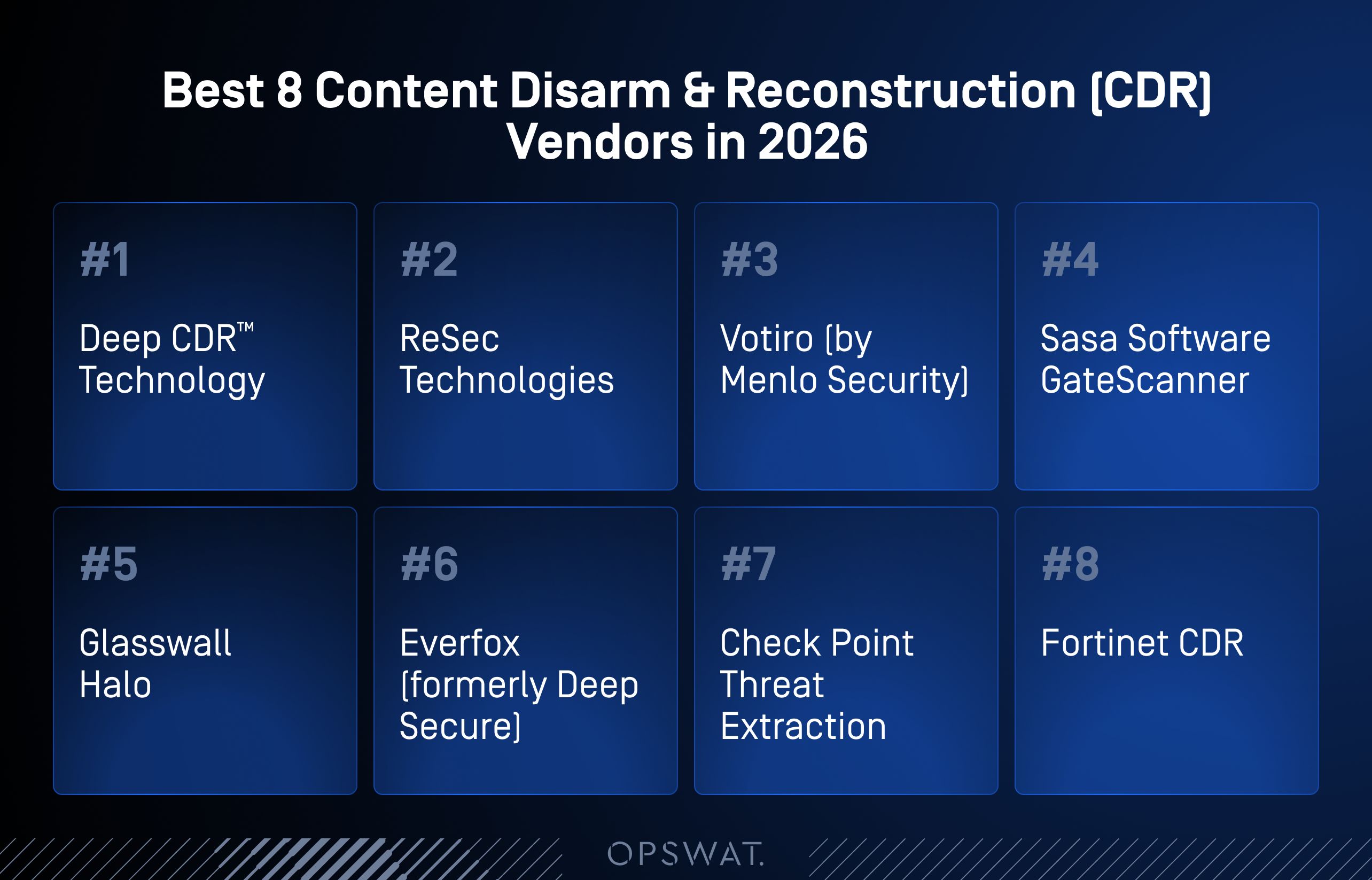
Best 8 Content Disarm and Reconstruction (CDR) Vendors in 2026

Choosing the right CDR vendor is critical for protecting your organization from file-based threats, zero-day vulnerabilities, and advanced persistent threats. Below is a curated list of the top 10 enterprise-grade CDR vendors in 2025. Each vendor is evaluated for its core capabilities, deployment flexibility, integration support, and real-world use cases.

#1 Deep CDR™ Technology – Industry Benchmark for File Sanitization

OPSWAT Deep CDR™ Technology is the company’s prevention‑first file sanitization engine within the MetaDefender® platform, purpose‑built for critical infrastructure and trusted file workflows. In independent evaluations, Deep CDR™ Technology became the first CDR solution to achieve 100% Protection and 100% Legitimate Accuracy in SE Labs testing.

技术概览

Deep CDR™ Technology verifies true file type and structure, creates a safe “placeholder,” disarms risky objects including macros, scripts, malformed structures, then regenerates a clean file with fully usable. Deep CDR™ Technology also augments with OPSWAT’s Metascan™ Multiscanning, Proactive DLP™, and Adaptive Sandbox technologies to enable multi-layered file security.

主要功能

  • Zero‑day neutralization without signatures or heuristics; protection against obfuscation and steganography tactics.
  • Proven efficacy: 100% in SE Labs CDR test; additional third‑party validation by SecureIQLab.
  • Flexible deployments across email, web, uploads, downloads, portable media, ICAP/API connectors, and gateways.

它是如何运作的?

  • Evaluate and verify true type/consistency, prevent masquerading
  • Create and hold a safe placeholder
  • Disarm and rebuild approved elements; regenerate structures
  • Deliver clean, functional files with audit details
优点缺点
  • High efficacy and strong file fidelity
  • AI-powered file type detection and archive recursion
  • CDR augmented with multiscanning, DLP (data loss prevention), and emulation-based sandbox supporting data security, threat detection and secure files across download, upload, transfer and sharing
  • Flexible deployment across common channels including air-gapped and cross-domain
  • Enterprise scope may exceed SMB needs
  • Best value when integrated with the broader MetaDefender stack

#2 ReSec Technologies – Intelligent File Firewall

ReSec focuses on Zero‑Trust gateway protection with its ReSecure platform, combining intelligent file‑type verification, multi‑engine detection, and real‑time CDR to eliminate both known and unknown file‑borne threats while preserving usability.

技术概览

ReSec CDR identifies true file types including embedded/archived content and then rebuilds fully functional replicas for unknown‑threat prevention. Originals are quarantined outside the organization for forensics.

主要功能

  • Quarantine‑by‑design of source files outside the network
  • Scalable, low‑latency architecture suited to high‑volume gateways
  • Channel coverage: email, web, removable media, file servers, and API flows

Deep CDR 如何运作

  • Quarantine originals externally
  • Identify true file type
  • Reconstruct clean replicas and deliver to destination
优点缺点
  • Strong forensic posture with preserved originals
  • Real time delivery with zero trust enforcement
  • Broad gateway coverage
  • Best for gateway centric architectures
  • Requires on premise resources for full control at scale

#3 Votiro (by Menlo Security) – Positive Selection Meets Browser Security

In February 2025, Menlo Security acquired Votiro, bringing Votiro’s advanced CDR and data security (DDR) into Menlo’s secure enterprise browser and workspace security portfolio that unites file safety across browser, email, collaboration tools, and API flows.

技术概览

Votiro’s positive‑selection CDR rebuilds files by allowing only known‑good elements, ensuring safe documents across ingress/egress channels; integrated within Menlo, it complements Zero Trust Access.

主要功能

  • Seamless workspace security: file flows protected across browser, email, SaaS, and collaboration apps
  • Enterprise scale with transparent user experience (no workflow disruption)

Deep CDR 如何运作

  • Intercept file movement (browser/email/API/collab)
  • Deconstruct & positively select safe components; rebuild clean file
  • Deliver safe, native‑format files to users and apps
优点缺点
  • Best fit for SaaS heavy, browser first enterprises
  • Minimal friction for users
  • CDR aligned with data security and secure browsing
  • Packaging and features continue to evolve after the acquisition
  • Traditional gateway centric environments may prefer other models

#4 Sasa Software GateScanner – Critical Infrastructure Specialist

Sasa’s GateScanner protects “every channel” (email, web downloads, secure MFT, removable media, ICAP/API) with CDR, originally designed for high‑threat, critical networks and widely adopted across government and ICS/OT.

技术概览

GateScanner deeply deconstructs files (including archives), strips active/risky content, and reconstructs policy‑compliant versions. It also offers cross‑domain transfer with GateScanner Injector (optical data diode) to move sanitized data across segregated networks.

主要功能

  • Inline email security (SEG or SMTP relay), browser download sanitization, removable‑media kiosks, and secure MFT
  • Active‑active scale and policy granularity; supports hundreds of file types
  • Microsoft ecosystem integrations (e.g., AppSource listing)

Deep CDR 如何运作

  • Disarm & reconstruct to eliminate zero‑day/polymorphic threats.
  • Deliver sanitized content across chosen channel (email/web/MFT/USB)
优点缺点
  • Best fit for OT, ICS, and cross domain data transfer
  • Wide channel coverage and proven in high-risk environments
  • Scalable with granular policy control
  • Multi component deployment can add operational overhead
  • Throughput depends on AV stack size and policy tuning

#5 Glasswall Halo – Defense-Grade File Protection

Glasswall delivers zero‑trust file protection through its CDR Platform (Halo), widely used by defense, intelligence, and highly regulated sectors; recent integrations (e.g., with ReversingLabs) add threat intelligence context to CDR operations.

技术概览

Glasswall validates files against the manufacturer’s known‑good specification, repairs deviations, removes risky elements per policy (e.g., macros, links), and rebuilds clean files that are aligned with NSA ISG guidance for inspection/sanitization.

主要功能

  • Kubernetes‑based scalability, REST/ICAP endpoints, and desktop/clean-room UX
  • Defense‑grade deployments and technical documentation for policy mapping

Deep CDR 如何运作

  • Inspect: break down and validate file structure.
  • Rebuild: correct/repair invalid structures.
  • Clean: remove high‑risk components by policy.
  • Deliver: semantic checks and output of clean file at speed.
优点缺点
  • High assurance model trusted by regulated sectors
  • Flexible SDK for embedding in custom workflows
  • Requires careful policy design to balance usability
  • Cluster and API setup skills needed for optimal performance

#6 Everfox (formerly Deep Secure) – Zero Trust Threat Removal

Everfox (the rebrand of Forcepoint’s federal unit) incorporates the Deep Secure CDR heritage acquired by Forcepoint in 2021. Everfox promotes Zero Trust CDR (a.k.a. Threat Removal) across cross‑domain and threat‑protection portfolios, also pairing with hardsec RBI in new cloud services.

技术概览

Everfox CDR extracts valid business information, verifies structure, and builds a brand‑new file to carry the information onward to prevent even unknown malware and exploits from surviving the transformation.

主要功能

  • Pixel‑perfect, fully revisable output; deterministic prevention
  • Cross‑domain pedigree and high‑assurance deployments for government/critical missions

Deep CDR 如何运作

  • Extract business data from the original file
  • Verify the extracted information is well‑formed
  • Rebuild a new file per specification, discard or store original
  • Deliver the safe, editable result
优点缺点
  • Prevention for the most sensitive environments
  • Combines isolation and CDR for broader protection
  • Focused on high assurance buyers
  • Pricing and processes often align to regulated sectors

#7 Check Point Threat Extraction – Instant File Sanitization

Check Point’s Threat Extraction (TE) is a CDR capability spanning Quantum network gateways and Harmony endpoint/email, operating alongside Threat Emulation sandboxing and powered by ThreatCloud AI intelligence.

技术概览

Threat Extraction preemptively removes active content (macros, embedded objects, scripts, links), optionally converts to PDF, and delivers clean files in seconds, while the original can be released post‑sandbox verdict when allowed.

Deep CDR 如何运作

  • Strip exploitable components on ingress
  • Reconstruct a safe version (often near‑instant)
  • Optionally release the original after sandbox approval (policy‑based)

Deep CDR 如何运作

  • Strip exploitable components on ingress
  • Reconstruct a safe version (often near‑instant)
  • Optionally release the original after sandbox approval (policy‑based)
优点缺点
  • Speed and convenience within the Check Point stack
  • Simple rollout for existing customers
  • Best fit if you run Check Point infrastructure
  • Access to originals may be delayed by sandbox policy

#8 Fortinet CDR – Built into FortiMail and FortiGate

Check Point’s Threat Extraction (TE) is a CDR capability spanning Quantum network gateways and Harmony endpoint/email, operating alongside Threat Emulation sandboxing and powered by ThreatCloud AI intelligence.

技术概览

Fortinet CDR strips active content in real time, treating all active components as suspect, then reconstructs sanitized files (“flat” copies). Admins can retain originals locally, quarantine them, or forward to FortiSandbox for analysis.

Deep CDR 如何运作

  • Intercept files (email/web/HTTP(S)/FTP).
  • Deconstruct & sanitize: remove macros, scripts, embedded links/objects
  • Reconstruct & deliver a clean file; retain or sandbox originals per policy

Deep CDR 如何运作

  • Intercept files (email/web/HTTP(S)/FTP).
  • Deconstruct & sanitize: remove macros, scripts, embedded links/objects
  • Reconstruct & deliver a clean file; retain or sandbox originals per policy
优点缺点
  • Easy activation for Fortinet environments
  • Flexible options using sandbox and ICAP
  • Requires proxy inspection and profile tuning in FortiGate
  • User experience depends on policy choices for links and macros

Comparing CDR Vendors: Features, Scalability, and Support

Comparison Table: Key Features and File Type Coverage

VendorUnique FeaturesFile Type CoverageProcessing Speed部署选项
OPSWAT Deep CDR™ TechnologyDeep verification and sanitization, file regeneration with fully usable content, customizable conversion, forensic sanitization reports, SE Labs 100% rating200+ file types, recursive archives, AI file type detectionMilliseconds per fileEmail, web, ICAP, portable media, Cloud
ReSec TechnologiesQuarantine originals outside network, intelligent file-type verification, zero-trust enforcementDetection supports 250+ types; CDR sanitizes 50+ typesMost files processed within seconds, scalable real-time architectureEmail, web, removable media, API, portable media, file servers, API flows
Votiro (Menlo Security)Positive selection approach, integrated with secure browser and SaaS security200+ file types, preserves macros and password-protected files"Milliseconds" for sanitization, designed for real-time flowsBrowser, email, SaaS, collaboration apps, API
Sasa Software GateScannerDeep deconstruction, optical data diode for cross-domain transfer, granular policy controlHundreds of file types (Office, PDF, media, archives, PST/OST, DICOM)Near real-time delivery; proven 98.99% success in testsEmail, web, secure MFT, removable media, ICAP/API
Glasswall HaloValidates against manufacturer specs, NSA ISG alignment, semantic checks85+ file types (Office, PDF, images, audio/video, executables, archives)Sub-second processingKubernetes clusters, REST/ICAP, desktop clean-room
Everfox (Deep Secure)Extracts business data, deterministic prevention, pixel-perfect outputOffice, PDF, structured dataNear real-time reconstructionCross-domain, high-assurance environments
Check Point Threat ExtractionInstant sanitization, optional PDF conversion, integrated with Threat Emulation40+ file types (Office, PDF, images, Ichitaro, Hanword)Instant sanitizationNetwork gateways, endpoints, email
Fortinet CDRBuilt into FortiMail/FortiGate, proxy-based inspection, sandbox integrationOffice, PDF, ZIP archives; stripsactive contentReal-time sanitizationEmail, network, ICAP, sandbox

Scalability and Enterprise-Readiness 

  • Check that the engine handles high volume processing with short median processing times
  • Confirm support for nested archives, large files, and bulk transfers
  • Review clustering, active modes, and policy versioning for change control
  • Ask for real world throughput benchmarks that match your channels

Integration with Existing Security Ecosystems

  • ICAP or API for reverse proxy and upload workflows
  • Email stack integration with SEG or API for cloud mail
  • Sandbox routing for original files and automated verdict actions
  • SIEM and SOAR connectors for alerting and workflow

Vendor Support, SLAs and Customer Satisfaction

  • 24x7 support with documented SLAs
  • Named technical contacts for deployment
  • Clear upgrade cadence and file type expansion roadmap
  • Reference customers in your industry or region

How to Evaluate and Select the Right CDR Vendor for Your Organization 

1. Independent Testing and Validation 

  • Has the solution been tested by independent labs or government agencies?
  • Can the vendor provide penetration test results and zero-day sample performance?

2. Integration and Workflow Fit

  • Does the solution integrate easily with your email, web, ICAP, and API workflows?
  • Is there clear REST API documentation and support for automation?

3. File Type Coverage and Roadmap

  • How many file types and archive formats are supported today?
  • How quickly can the vendor add new file types, including regional formats like HWP or JTD?

4. Performance and Scalability

  • What is the average processing time per file type?
  • Can the solution handle large files, nested archives, and high-volume traffic without latency?

5. Policy Flexibility

  • Can you apply different policies for internal vs. external channels?
  • Can you fine-tune sanitization (e.g., allow macros internally but strip them externally)?

6. Security and Development Practices

  • Does the vendor follow secure SDLC and code review processes?
  • Are third-party libraries properly licensed and maintained?

7. Auditability and Compliance

  • Does the solution create detailed logs and audit trails?
  • Can it verify archive integrity and provide compliance reporting?

8. Usability Preservation

  • Does the rebuilt file retain critical functionality like PowerPoint animations or Excel formulas?
  • Test with real-world samples to confirm usability.

9. Vendor Sustainability and Support 

  • How many engineers actively maintain the CDR engine?
  • What is the release cadence and roadmap for enhancements?

Select the right CDR Vendor

Learn everything you need to know about finding the right CDR vendor for your organization.

CDR in Action: Enterprise Use Cases and Success Stories

Fortinet provides CDR as a FortiGuard Security Service and implements CDR in FortiMail and FortiGate antivirus profiles (proxy‑based inspection). CDR is part of Fortinet’s broader Zero‑Trust strategy, augmenting NGFW, email, and sandbox layers.

Vendor Sustainability and Support 

Protect inbound email attachments and documents exchanged in collaboration platforms. Maintain productivity while neutralizing embedded risk.

Web downloads and uploads

Verify and sanitize files downloaded from the internet and validate files uploaded to portals and applications, including customer-facing workflows.

Secure file transfer and cross domain

Move files between segregated networks and tiers with enforced policy and auditability, including optical data diode integrations.

OT and critical infrastructure

Control removable media and contractor file flows into plant or field environments, ensuring that only safe files cross trust boundaries.


常见问题

Are there free or open-source content disarm and reconstruction tools available?

Some community tools exist, but enterprise requirements usually demand commercial tools for coverage, performance, integration, and support.

How does CDR differ from traditional antivirus or sandboxing technologies?

Antivirus and sandbox tools detect and decide. CDR rebuilds files into safe versions, so threats are neutralized before delivery. Most programs use both.

What file types and formats are typically supported by enterprise CDR solutions?

Office, PDF, images, media, HTML, and common archive formats are widely supported. Advanced engines also handle nested archives and specialty formats.

查看更多支持的文件类型

Can CDR solutions be integrated with cloud storage and collaboration platforms?

Yes. Look for native APIs and connectors, plus ICAP and reverse proxy options for flexible routing.

What are the potential limitations or drawbacks of CDR technology?

Overly strict policies can impact usability. This is manageable with policy design, allow lists, and workflow exceptions.

How quickly can CDR tools process large volumes of files?

Modern engines deliver clean files in seconds at scale. Always validate throughput against your real volumes and channels.

Is user training required to effectively deploy and operate CDR solutions?

Minimal, since CDR is transparent for most users. Admins should be trained on policy, exceptions, and reporting.

How do CDR vendors handle updates for new file types or emerging threats?

Through regular engine updates, new file type modules, and policy packs. Ask for the roadmap and release cadence.

What are common mistakes organizations make when implementing CDR?

Underestimating volume and recursion depth, using default policies without tuning, skipping pilots for key workflows, and neglecting reporting and RBAC.

通过OPSWAT 了解最新信息!

立即注册,即可收到公司的最新动态、 故事、活动信息等。